DOMESTIC HOLIDAY TRENDS DUTCH POPULATION
REPORT HOLIDAY TRENDS 2024
Periodically, Seeker Insights publishes public reports on trends or general developments in an industry. This report on the holiday behaviour of the Dutch population is an example.
This report covers general holiday trends, based on data published by CBS and Eurostat. The findings from this report are useful for a wide audience within the tourism and holiday industry. Although this report gives only a small insight into the complex world of the holiday behaviour of the Dutch population, we make this basic report publicly available in the hope that organisations in this industry will gain new insights, and realise the value of using data.
Below, we will discuss some key findings from the report.
Are you interested in the full report including recommendations for the industry? Then contact us via our contact form, email or phone number. We will then send this report to you free of charge.
POPULARITY OF PROVINCES AS DOMESTIC HOLIDAY DESTINATION
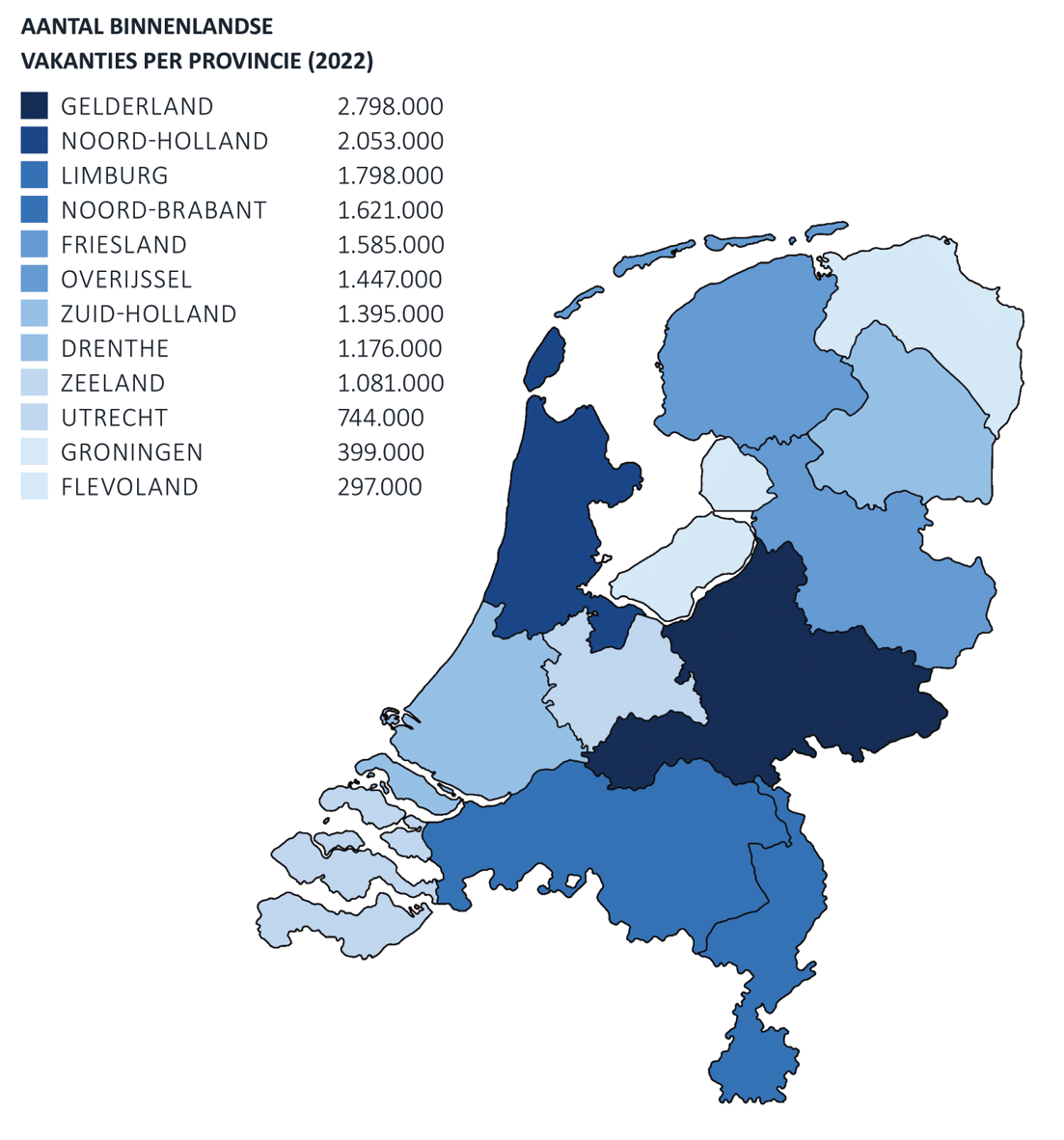
An overview and visualisation of the popularity of the 12 Dutch provinces as domestic holiday destinations reveals that Gelderland is by far the most popular destination. This province, known for the Veluwe, numerous parks, sights, museums and other attractions, tops the list with nearly 2.8 million holidays in 2022.
North Holland, where capital Amsterdam is traditionally the main attraction, follows at a suitable distance with over 2 million holidays. Furthermore, the southern provinces of Limburg and Noord-Brabant are also popular, where nature as well as local identity and culture play a major role. The northern provinces, the southern part of the Randstad, Flevoland and Zeeland are relatively less popular as holiday destinations.
In the full report, we further explore the popularity of the 12 provinces as holiday destinations, and also analyse the popularity trend of the past and coming years.
HOLIDAY DURATION & HOLIDAY SPENDING BY PROVINCE FOR DOMESTIC HOLIDAYS
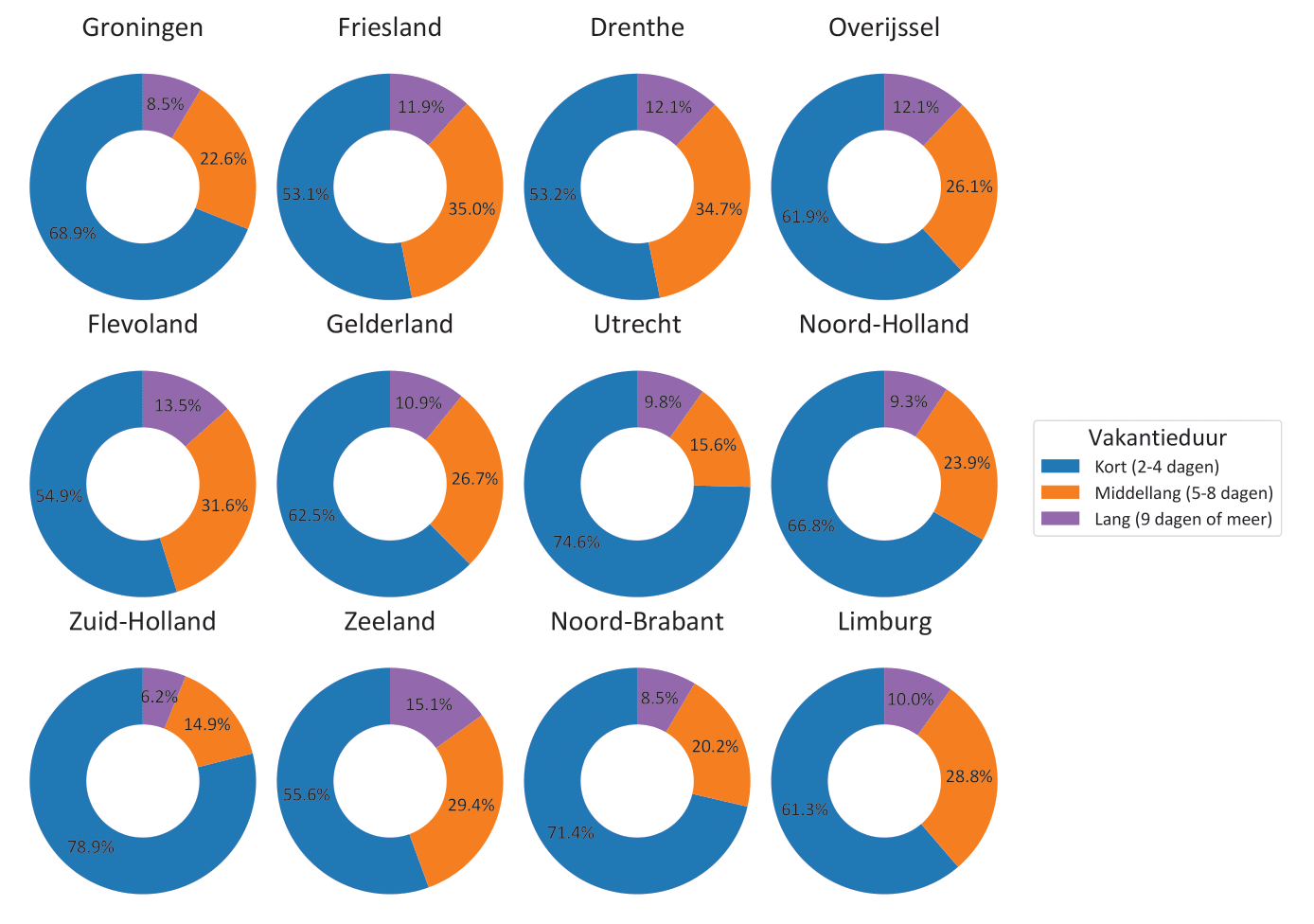
An analysis of the duration of domestic holidays within the 12 provinces shows that Dutch people predominantly choose short domestic holidays. Not surprisingly, short holidays are especially popular in the Randstad provinces. The high proportion of short holidays is also noticeable in Groningen and North Brabant. This is because Dutch people relatively often head to these provinces for city trips, which often last only a few days or a weekend.
In contrast, we see in provinces with a stronger rural identity that Dutch people are relatively more likely to opt for medium- or long-term holidays. In these provinces, people tend to opt for more relaxation, rest or visiting a wider range of attractions, holiday destinations for which they usually spend more days.
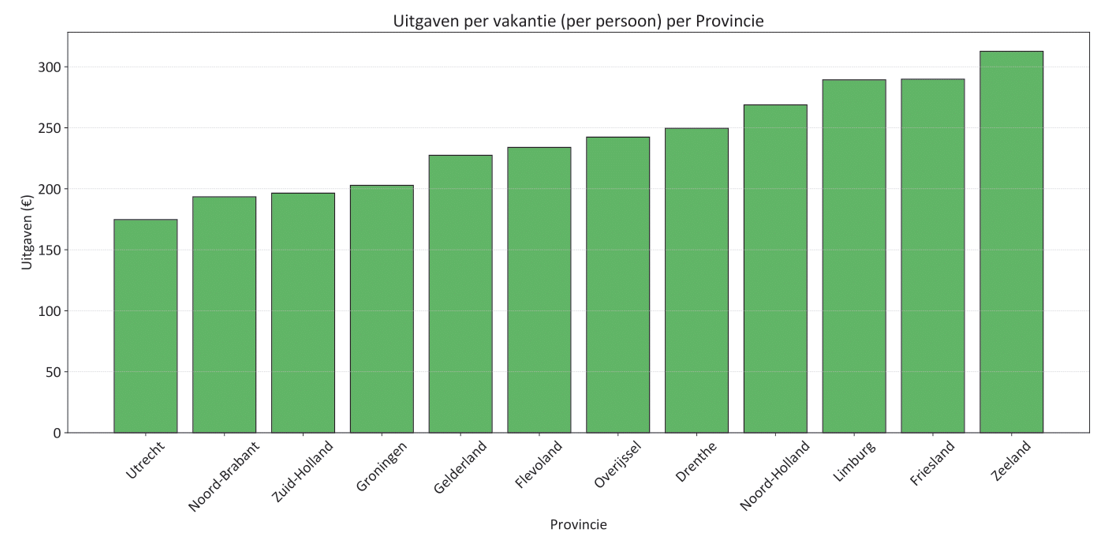
As expected, there is a strong visual correlation between holiday length within a province and average spending per holiday per person per province. The provinces with the highest proportion of short holidays also show predominantly lower average spending per holiday per person. This can be explained by the smaller number of overnight stays, but also by the often urban nature of these holidays, where many attractions are public and close to each other. This often eliminates travel, ticket, rental and activity costs.
HOLIDAY TYPE & ACCOMMODATION TYPE BY PROVINCE FOR DOMESTIC HOLIDAYS
HOLIDAY CITY
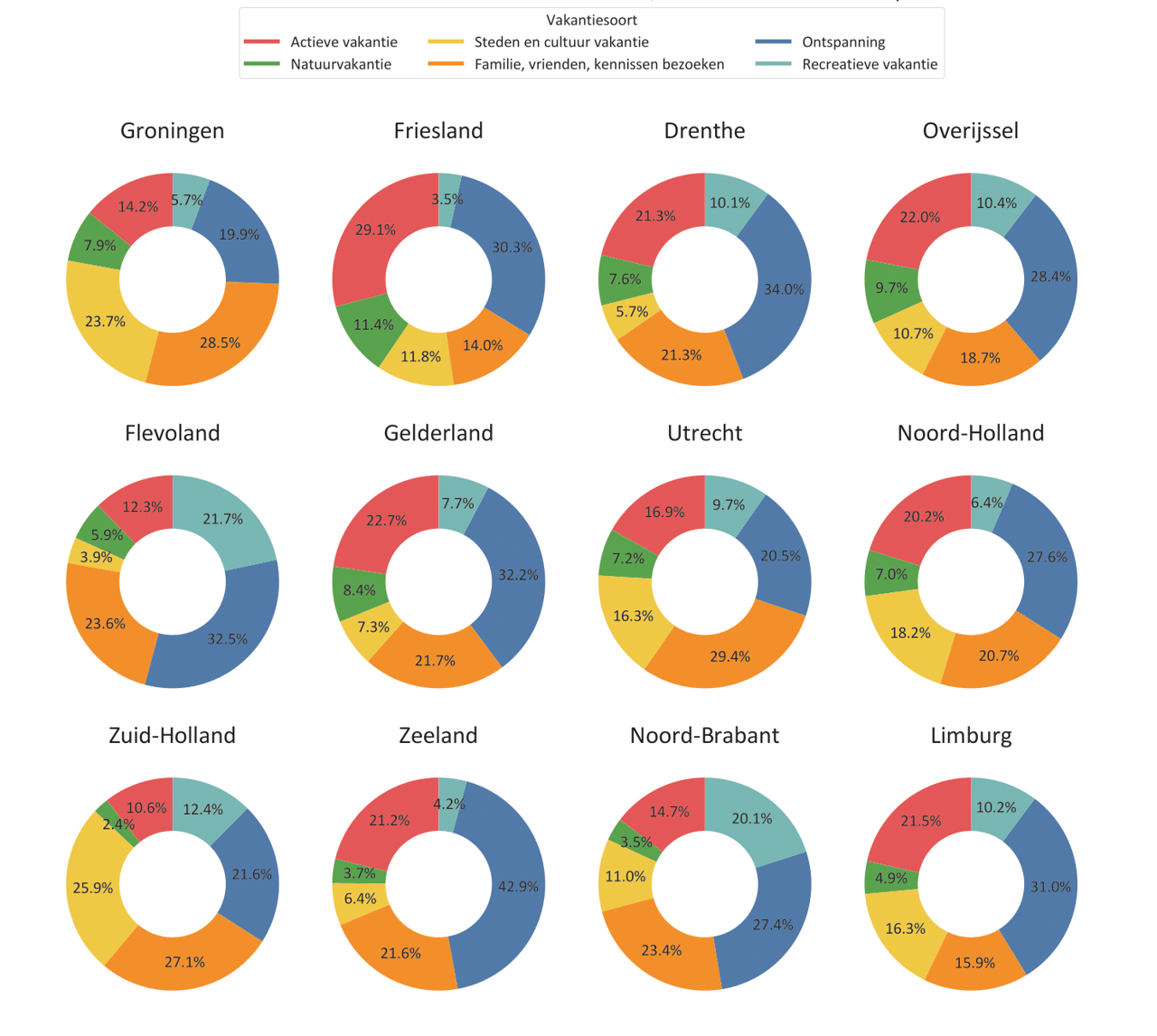
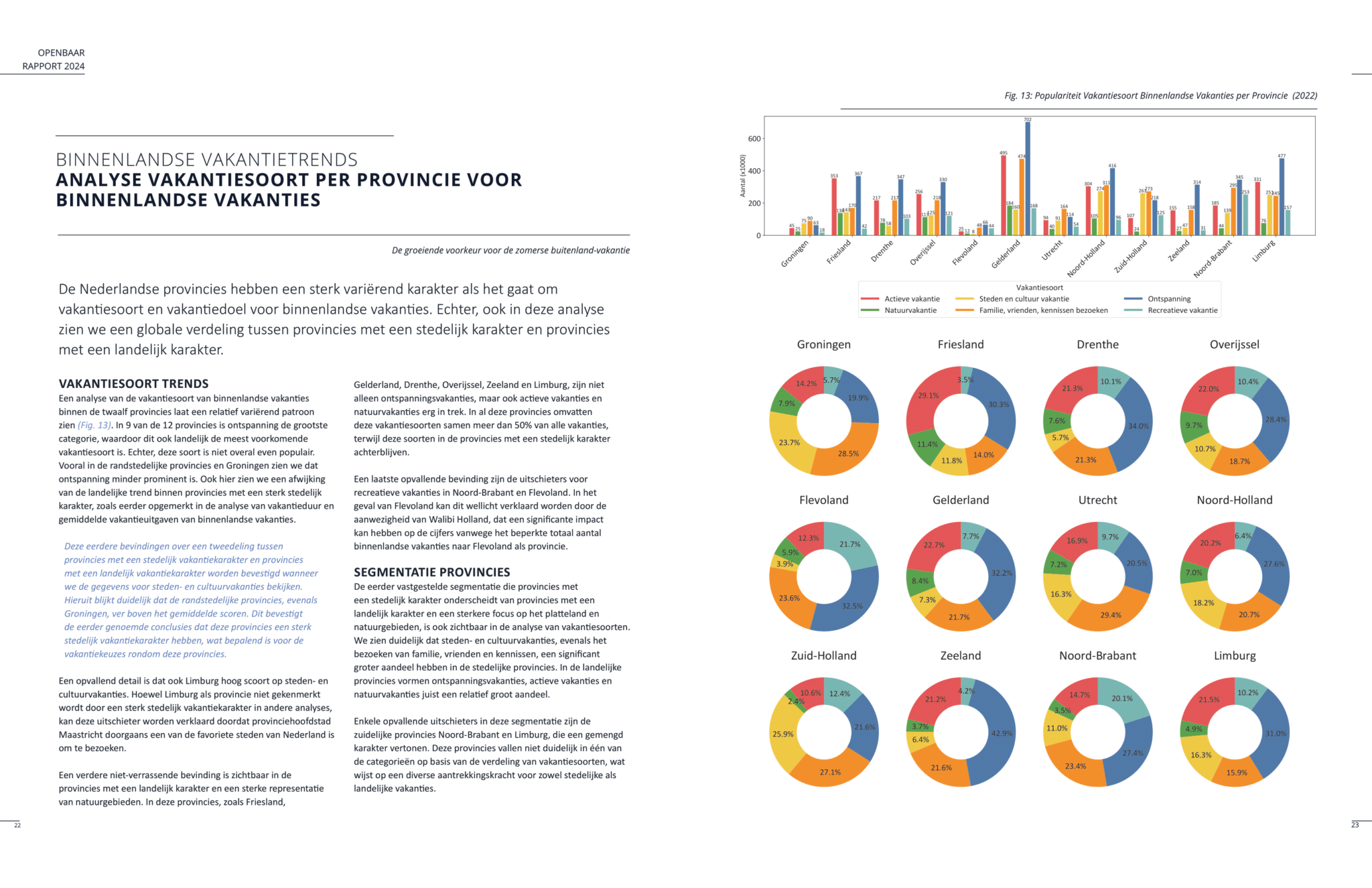
An analysis of the holiday type of domestic holidays within the 12 provinces shows a relatively varying pattern. In 9 of the 12 provinces, relaxation is the largest category, making it also the most common type of holiday nationwide. However, this type is not equally popular everywhere. Especially in the Randstad provinces and Groningen, we see that relaxation is less prominent. Again, we see a deviation from the national trend within provinces with a strong urban character, as noted earlier in the analysis of holiday duration and average holiday expenditure of domestic holidays.
A striking detail is that Limburg also scores high on city and cultural holidays. Although Limburg as a province is not characterised by a strong urban holiday character in other analyses, this outlier can be explained by the fact that provincial capital Maastricht is usually one of the Netherlands' favourite cities to visit.
A further unsurprising finding is visible in provinces with a rural character and a strong representation of natural areas. In these provinces, such as Friesland, Gelderland, Drenthe, Overijssel, Zeeland and Limburg, not only relaxation holidays, but also active holidays and nature holidays are in high demand. In all these provinces, these holiday types together comprise more than 50% of all holidays, while these types lag behind in urban provinces.
In the full report, we analyse notable outliers within provinces and their causes. We also outline a detailed province segmentation based on this data.
ACCOMMODATION TYPE
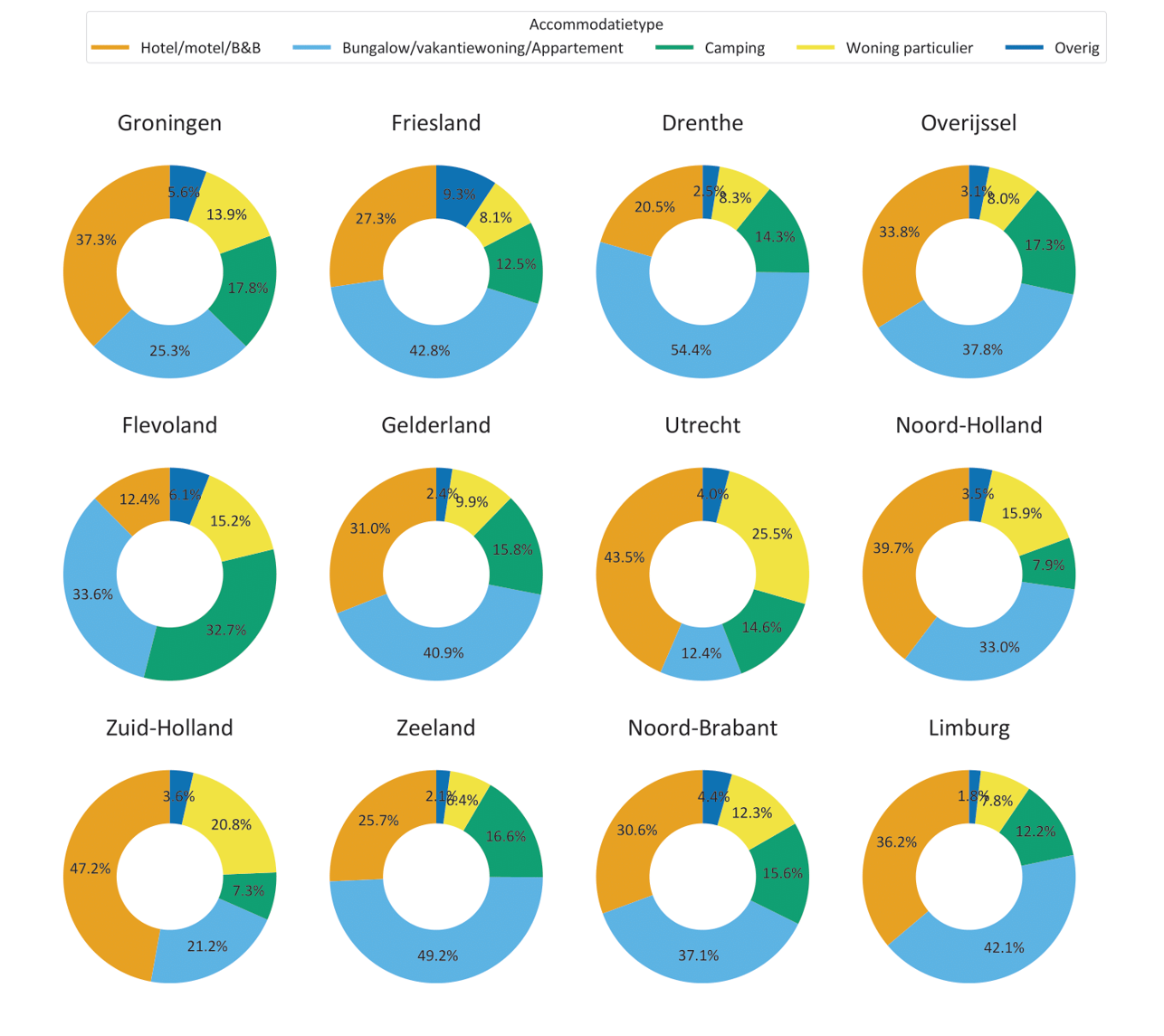
A review of the accommodation types chosen for domestic holidays shows a greater degree of diversity between provinces than previous analyses. In 8 of the 12 provinces, the bungalow/holiday home/apartment category is the most prominent. In the remaining 4 provinces, the hotel/motel/B&B category is the most popular.
Not unexpectedly, we also see in this analysis a division between the peripheral provinces and Groningen on the one hand, and the rural provinces on the other. In the provinces with a strong urban character, hotels, motels and B&Bs are the most popular, which can be explained by their large presence in urban areas. The prominent role of bungalows, holiday homes and flats in the rest of the country coincides with the increase in space and the desire for peace and privacy. In addition, we see that private homes are especially popular in the Randstad provinces.
In the full report, we also paint a picture of the national trend of accommodation types, and further extend our province segmentation.
DEMOGRAPHIC CHARACTERISTICS OF TRAVELERS BY PROVINCE FOR DOMESTIC HOLIDAYS
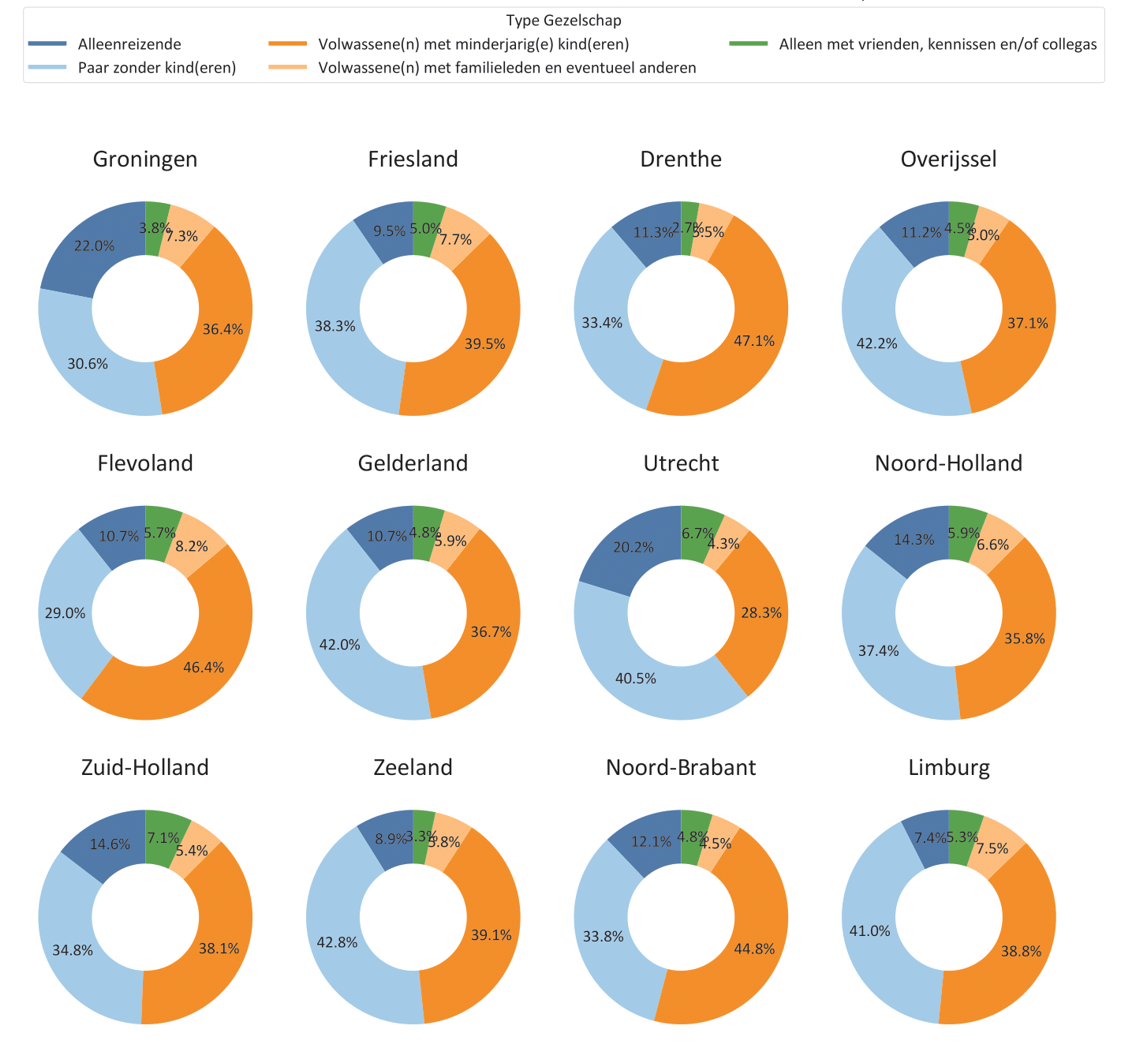
Data on demographic characteristics and travel company of domestic holidays give a reasonably balanced picture of the proportions among the 12 provinces. A striking finding is the number of single travellers in the Randstad provinces and Groningen, which again stands out slightly from the rest of the provinces. These four provinces with an urban holiday character have a relatively higher proportion of single travellers. This trend is consistent with previously discovered trends that these provinces are characterised by city and cultural holidays, and that travellers mainly choose hotels, motels and B&Bs. These are patterns that fit well with holidaymakers travelling alone. Apart from the proportion of single travellers, no clear patterns can be detected that clearly distinguish the 12 provinces. Some striking figures that cannot be directly linked to patterns include the limited number of single travellers to Limburg, the limited number of adults with minor children or other family members who choose Utrecht as a holiday destination, and the relatively large number of large groups (8 or more) in North Brabant.
PROVINCE SEGMENTATION FOR DOMESTIC HOLIDAYS
The analysis of the various domestic holiday trends shows a clear segmentation between provinces with an urban holiday character and provinces with a rural holiday character. This segmentation results in the following profiles.
The provinces with an urban holiday character - This category includes the peripheral provinces (North Holland, South Holland and Utrecht), and the province of Groningen. These provinces are characterised by a preference for shorter holidays, lower average spending per holiday per person, a preference for city and cultural holidays, and a higher popularity of accommodation such as hotels, motels and B&Bs. We also see in these provinces that Dutch people are more likely to go on holiday to these provinces for the purpose of visiting friends or family.
The provinces with a rural holiday character - This category includes the provinces of Friesland, Drenthe, Overijssel, Flevoland, Gelderland, Zeeland, North Brabant and Limburg. These provinces actually attract visitors who more often opt for relaxation, nature and longer stays, often in accommodation such as bungalows and holiday homes. These provinces also have slightly higher average spending per person per holiday, and see fewer single travellers.
While the segmentation into urban and rural holiday character offers a useful and often accurate classification, there are also exceptions that make a perfect separation difficult. A good example is the province of Limburg. Although Limburg generally has a strong rural holiday character, as evidenced by holiday length, purpose of holidays, and composition of travel company, the province also has a relatively high proportion of urban and cultural holidays. This is atypical for a province with a rural holiday character and is largely explained by the popularity of Maastricht, one of the most visited cities for domestic trips.
In the full report, we reveal a detailed province segmentation. We also highlight the strengths and weaknesses of this segmentation, and how organisations in the domestic tourism and holiday industry can use this segmentation. Finally, we also provide concrete advice for organisations within these sectors to use this segmentation and domestic holiday trends to their advantage.
INTERESTED IN THE FULL REPORT?
Periodically, Seeker Insights publishes public reports on trends or general developments in an industry. This report on the holiday behaviour of the Dutch population is an example.
This report covers general holiday trends, based on data published by CBS and Eurostat. The findings from this report are useful for a wide audience within the tourism and holiday industry. Although this report gives only a small insight into the complex world of the holiday behaviour of the Dutch population, we make this basic report publicly available in the hope that organisations in this industry will gain new insights, and realise the value of using data.
Are you interested in the full report including recommendations for the industry? Then contact us via our contact form, email or phone number. We will then send this report to you free of charge.
GENERAL HOLIDAY TRENDS DUTCH POPULATION
REPORT HOLIDAY TRENDS 2024
Periodically, Seeker Insights publishes public reports on trends or general developments in an industry. This report on the holiday behaviour of the Dutch population is an example.
This report covers general holiday trends, based on data published by CBS and Eurostat. The findings from this report are useful for a wide audience within the tourism and holiday industry. Although this report gives only a small insight into the complex world of the holiday behaviour of the Dutch population, we make this basic report publicly available in the hope that organisations in this industry will gain new insights, and realise the value of using data.
Below, we will discuss some key findings from the report.
Are you interested in the full report including recommendations for the industry? Then contact us via our contact form, email or phone number. We will then send this report to you free of charge.
HOLIDAY PARTICIPATION
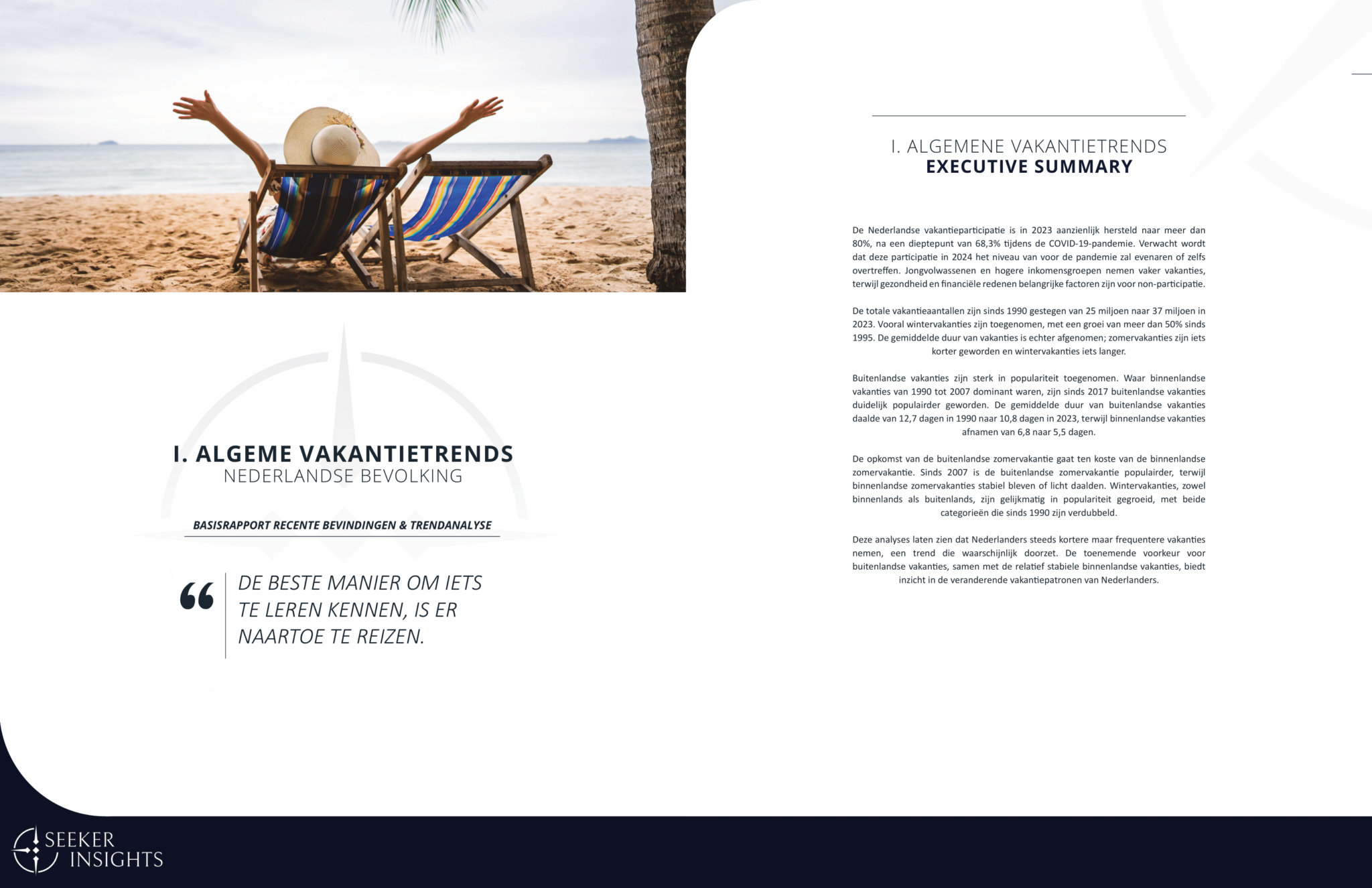
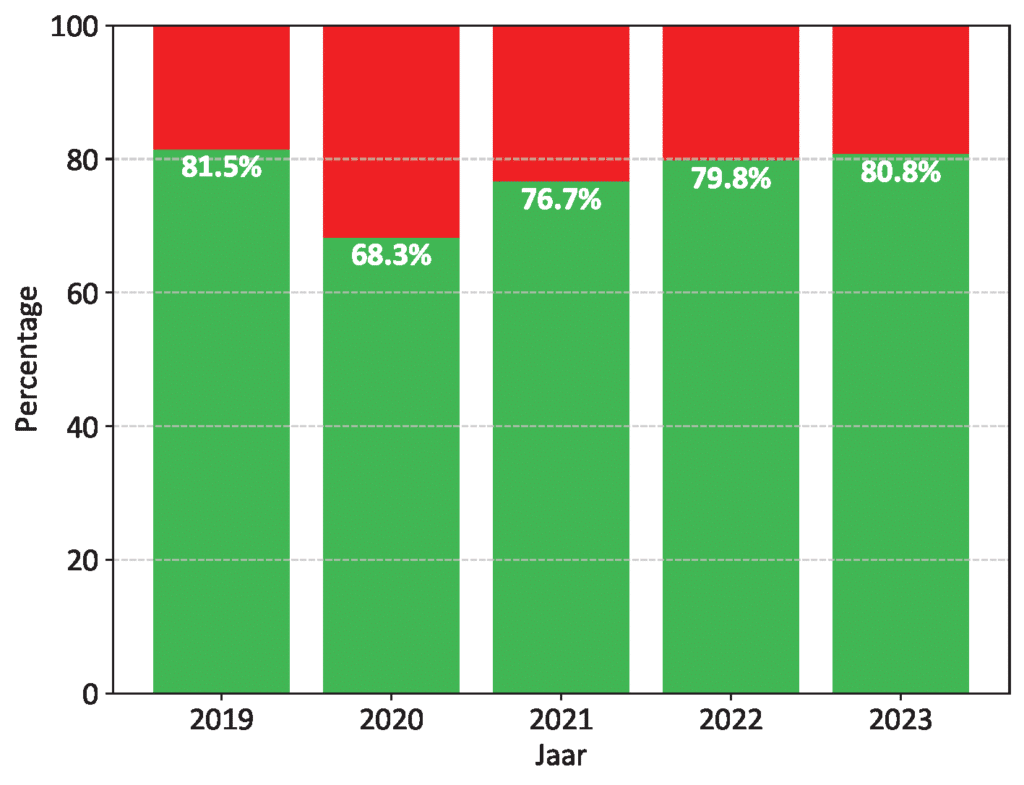
With a holiday participation rate of 80.8%, the Netherlands scores well above the European average and is almost back to pre-COVID-19 levels. Although age and income are important predictors of holiday participation, they are not the only determining factors. The post-crisis recovery has been rapid, and holiday participation is expected to fully recover by 2024. It is likely to continue hovering around 82% in the coming years, depending on economic developments. Although rising inflation may have a negative impact, no major effect is expected.
HOLIDAY FREQUENCY & DURATION
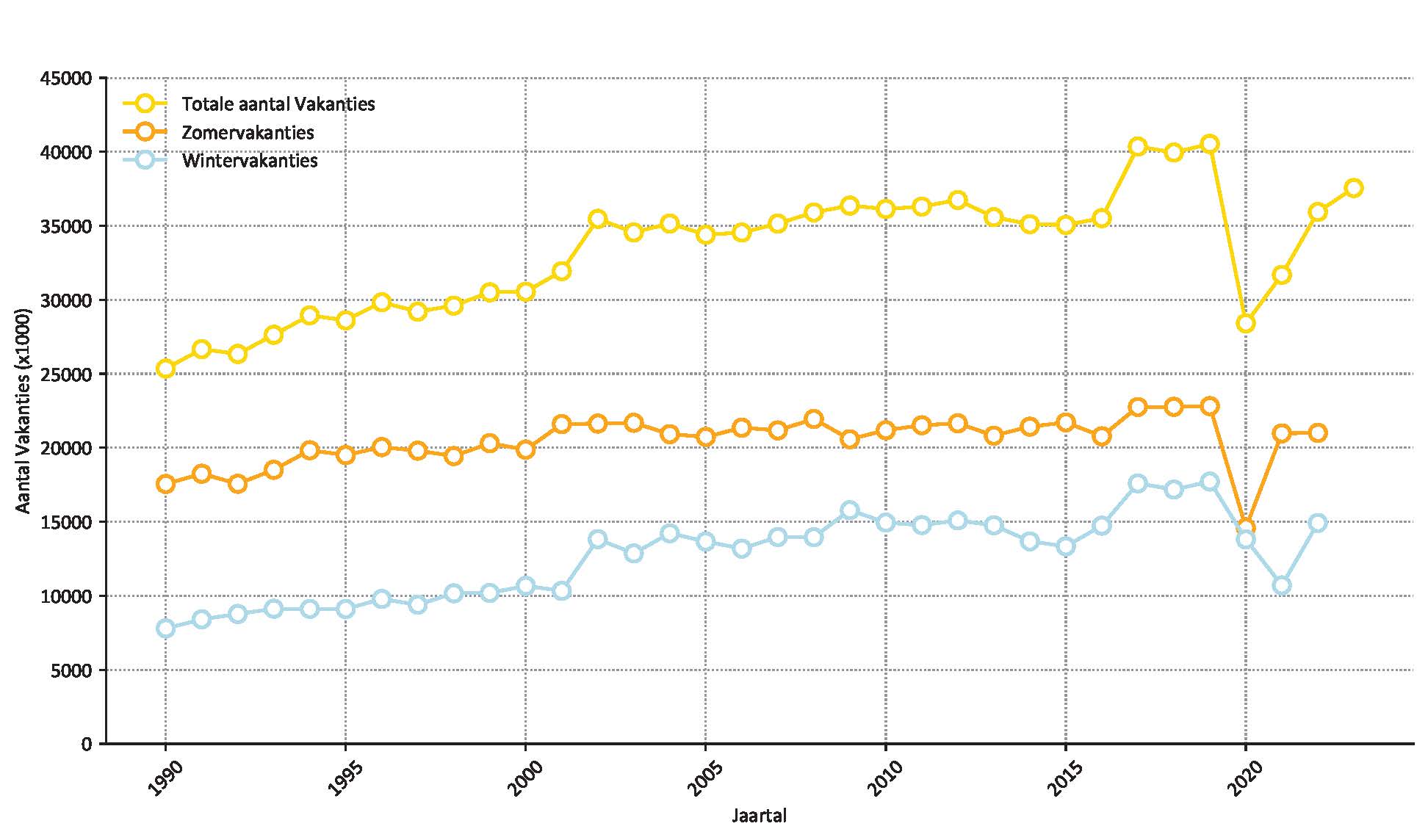
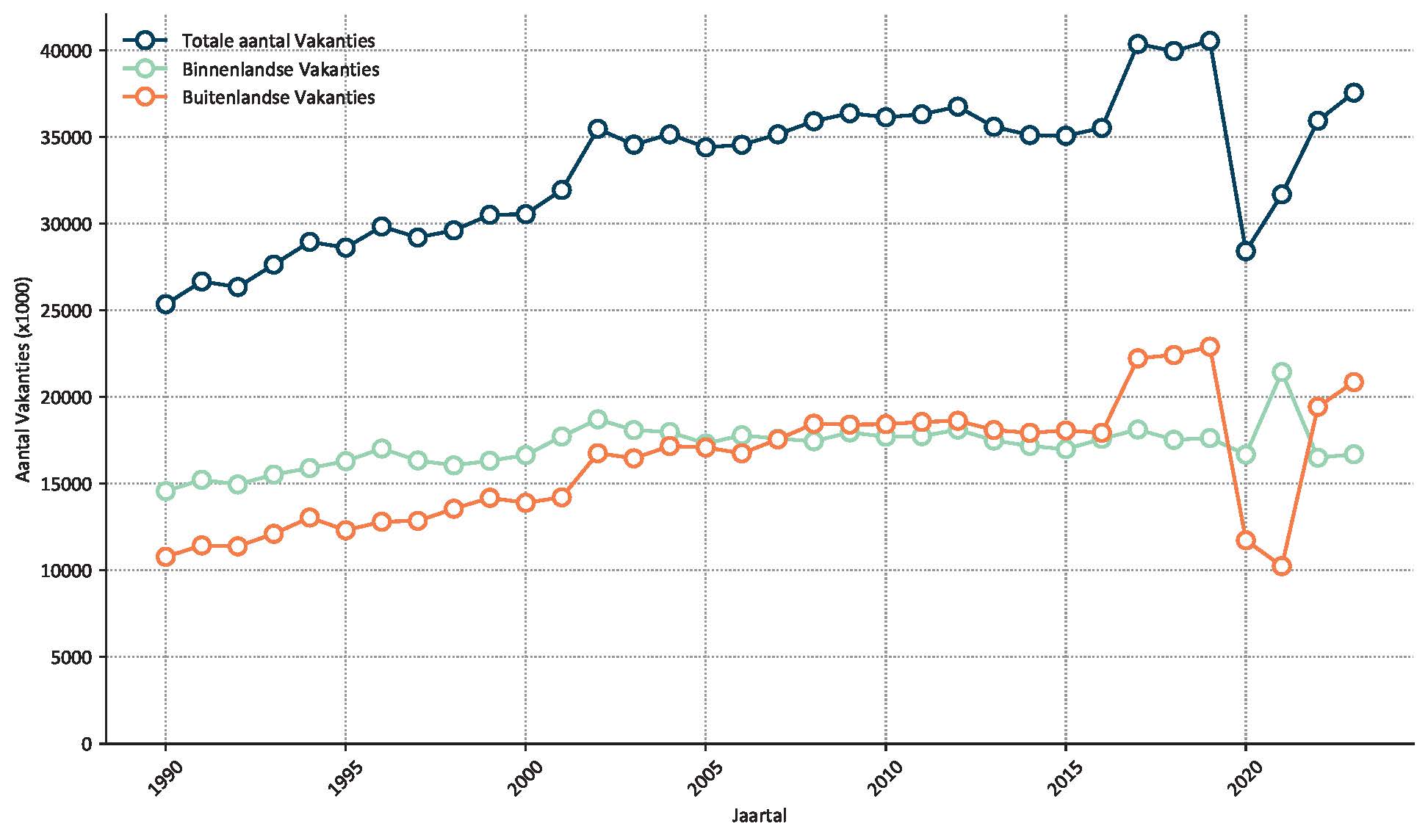
The number of holidays taken by the Dutch population has increased from 25 million since 1990 to over 37 million in 2023. This number is expected to remain stable in the coming years, with possibly slight growth. This stable development is due to the already high holiday participation rate, flattening population growth and an ageing population. Nevertheless, slight growth may be supported by the increasing number of short holidays taken by Dutch people every year. More and more people are opting for several shorter holidays instead of one long holiday, which increases the total number of holidays.
Average holiday duration, both domestic and foreign, has gradually declined over the years. This trend seems to be stabilising, but a slow continuation is likely. Young adults and people with higher incomes in particular have developed a preference for shorter, more frequent holidays. This is partly due to more available holidays and flexible work schedules. This trend is expected to spread further, supported by a growing highly educated population, favourable working conditions due to labour shortages, and increased flexibility in work, partly due to the COVID crisis. As a result, more and more Dutch people will spread their holidays over the year with several short trips instead of one long holiday.
In the full report, we elaborate on the forecasts of holiday frequency and holiday duration of the Dutch holidaymaker. We also draw up a series of recommendations for organisations within the tourism and holiday industry to best respond to these trends and forecasts.

SUMMER AND WINTER HOLIDAY TRENDS
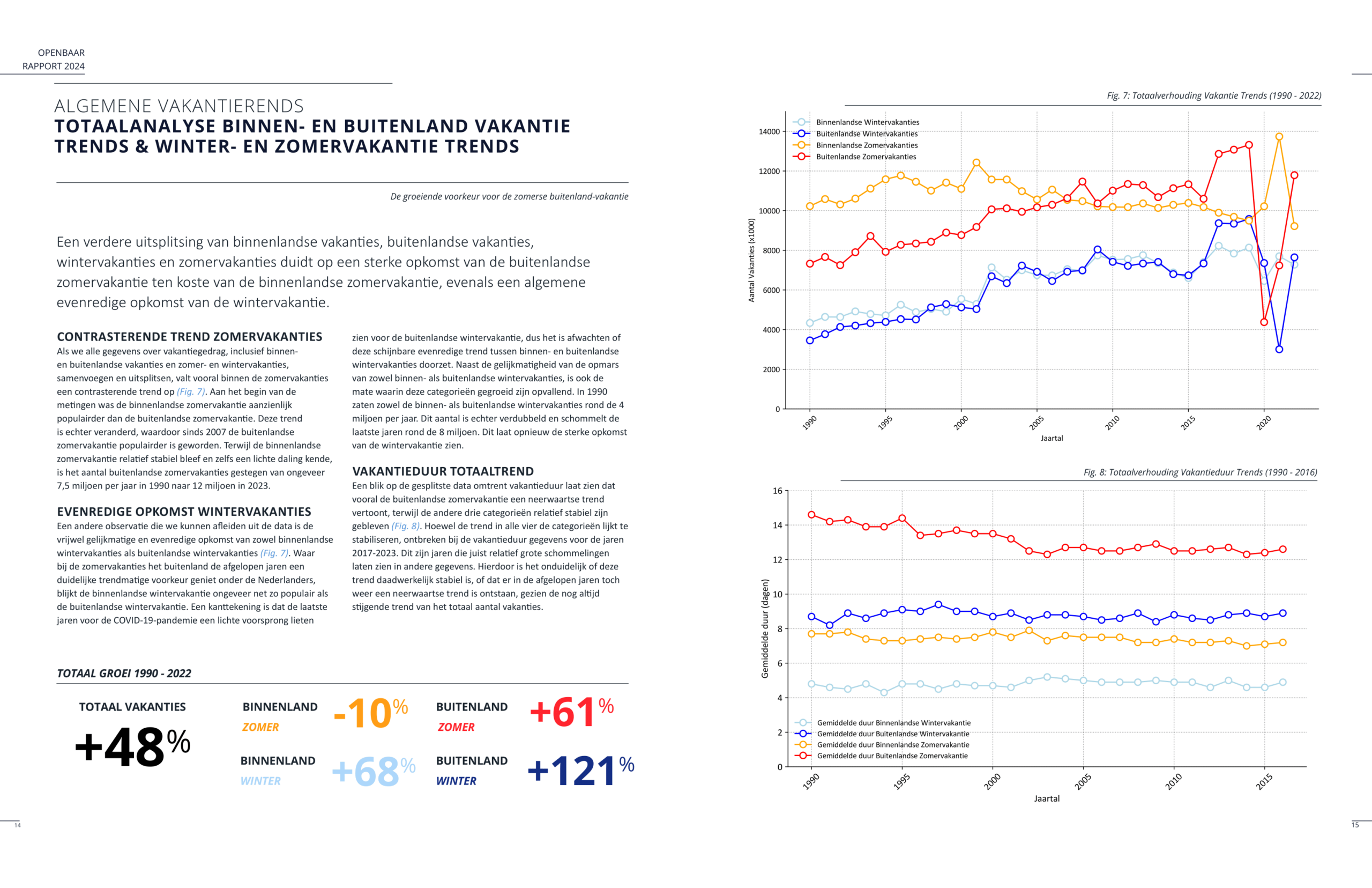
The number of winter holidays has increased sharply since the 1990s, from less than 8 million in 1990 to over 15 million in 2022. This growth applies to both domestic and foreign winter holidays, although foreign winter holidays have experienced a greater increase and have come to dominate in number in recent years. This indicates a shift in Dutch people's preference for holidays outside the traditional high season.
In this report, 'winter holidays' include all holidays taking place between October and March, regardless of destination or purpose, and not just winter sports holidays.
The advance of winter holidays is expected to continue in the coming years. The number of winter holidays is likely to move closer to the total number of summer holidays, although it will not surpass them. Foreign winter holidays in particular are expected to continue to grow and further extend their lead over domestic winter holidays.
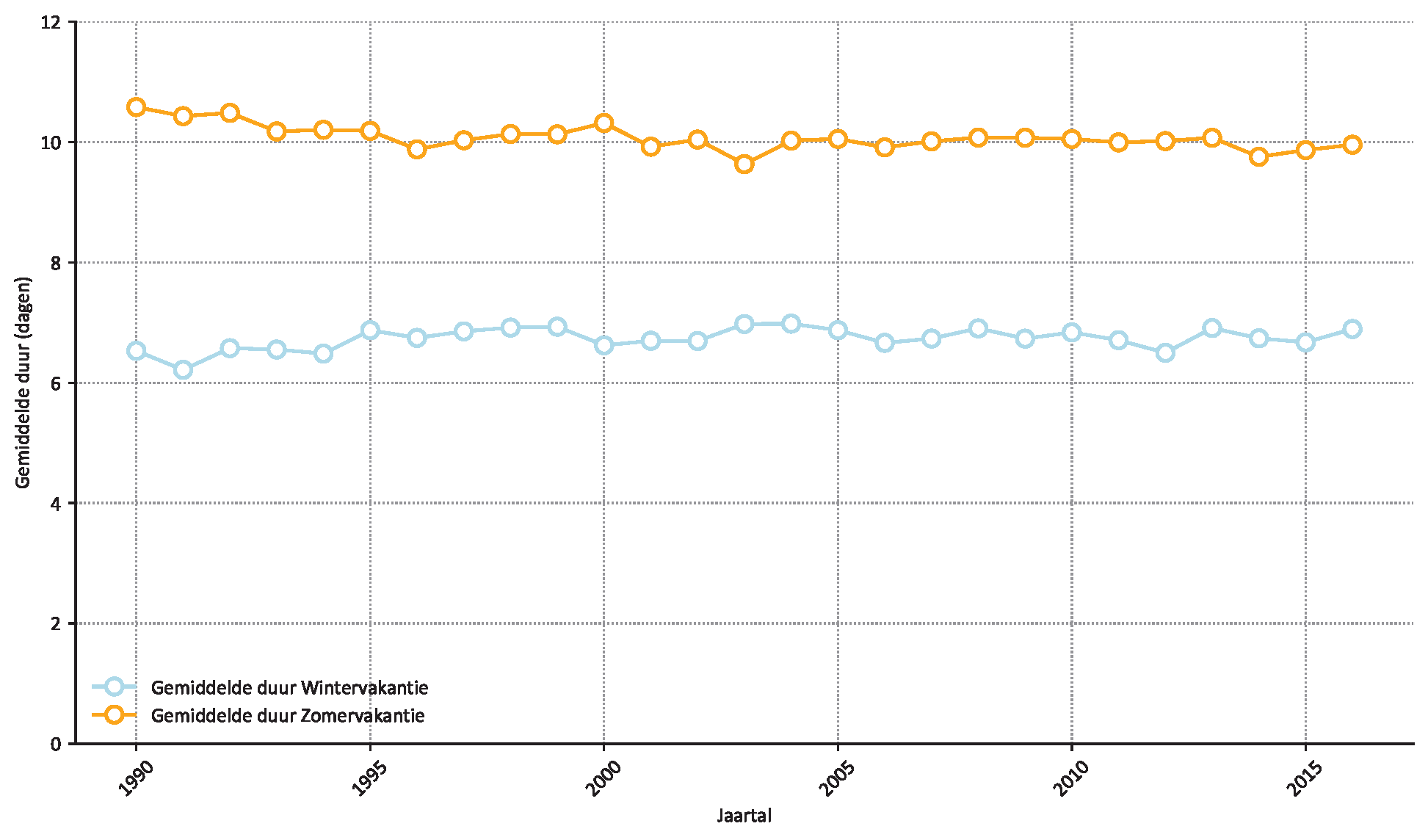
Average holiday duration has remained relatively stable since 1990, although a slight contrasting trend can be seen between summer holidays and winter holidays. Summer holidays have become slightly shorter over the years, from an average of 10.58 days in 1990 to 9.95 days in 2016. In contrast, winter holidays have actually become slightly longer, from an average of 6.53 days in 1990 to 6.89 days in 2016.
In the full report, we look in more detail at expectations for summer and winter holidays, and highlight the increasingly complex and diverse needs of holidaymakers. We also look at how Summer and Winter Holiday Trends and Domestic and Foreign Holiday Trends interact, and how organisations can take advantage of this.
DOMESTIC AND INTERNATIONAL HOLIDAY TRENDS
From 1990 to about 2007, domestic holidays were very popular and outnumbered foreign holidays. During this period, the number of domestic holidays increased from about 15 million in 1990 to over 17 million in 2007, a growth of about 13%. However, this growth was far outpaced by the increase in foreign holidays, which rose from about 10.5 million to over 17 million during the same period, representing a growth of over 60%. Although the COVID pandemic temporarily boosted domestic tourism, the growing preference for foreign holidays is expected to continue. In the coming years, the number of foreign holidays is likely to rise again towards 23 million and possibly pass 25 million before 2030, depending on positive economic developments.
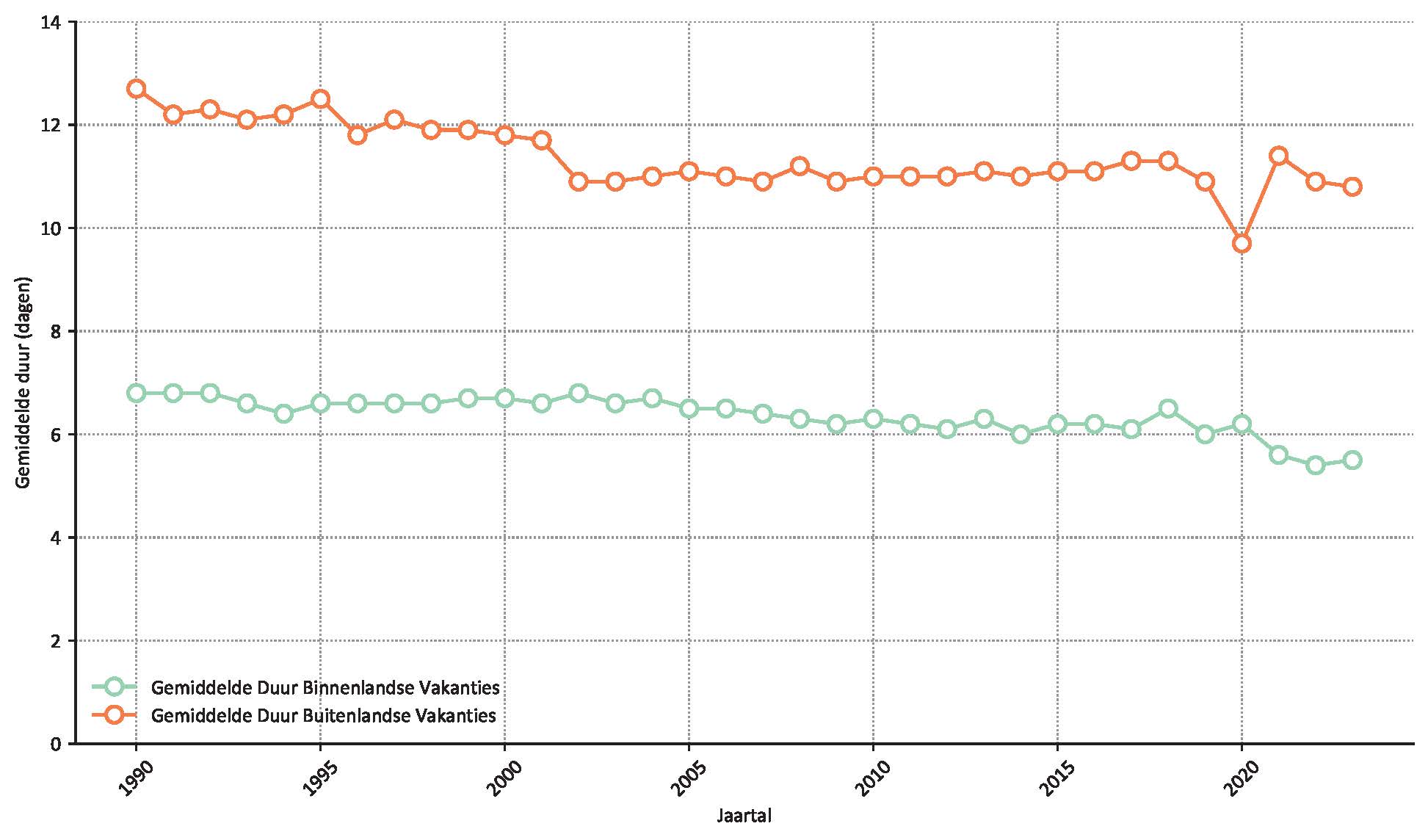
An analysis of average holiday length reveals a striking trend (Fig. 6). Both domestic and foreign holidays of the Dutch population are getting shorter on average. The average duration of a foreign holiday fell from 12.7 days in 1990 to 10.8 days in 2023, while the average duration of a domestic holiday fell from 6.8 days in 1990 to 5.5 days in 2023. The decline in the average duration of foreign holidays occurred mainly between 1990 and 2002 and remained fairly stable thereafter, although a tentative decline is again visible in recent years. The average duration of domestic holidays was very stable since 1990 and showed only a very slight gradual decline, although this decline also seems to be getting stronger in recent years.
From this analysis, it can be concluded that the average holidays of the Dutch population are getting shorter and shorter and this trend will continue for the time being. Incidentally, this is quite compatible with the increasing trend in the total number of holidays. The Dutchman has discovered the short but sweet holiday and more and more people are opting for several shorter holidays instead of one or two long holidays per year.
In the full report, we analyse the impact of the changing relationship between domestic and foreign holidays. We also look at how Summer and Winter Holiday Trends and Domestic and Foreign Holiday Trends interact, and how organisations can take advantage of this.
INTERESTED IN THE FULL REPORT?
Periodically, Seeker Insights publishes public reports on trends or general developments in an industry. This report on the holiday behaviour of the Dutch population is an example.
This report covers general holiday trends, based on data published by CBS and Eurostat. The findings from this report are useful for a wide audience within the tourism and holiday industry. Although this report gives only a small insight into the complex world of the holiday behaviour of the Dutch population, we make this basic report publicly available in the hope that organisations in this industry will gain new insights, and realise the value of using data.
Are you interested in the full report including recommendations for the industry? Then contact us via our contact form, email or phone number. We will then send this report to you free of charge.